TL;DR: Attempt to reduce one of the main frictions for agentic transactions on Stacks by supporting their gas activity.
Bigger picture: Position Stacks as the go-to agentic layer for Bitcoin.
This proposal tackles the gas side of the problem, but other technical solutions could also make agentic activity easier on Stacks.
Shoutout to the amazing work the AI BTC team has been doing! Check out their MCP Server work to support the agentic layer. I hope the community can work together to add more strategic focus in supporting an AI-driven agentic future for Bitcoin and Stacks. Currently, I don’t see much of this reflected in the Stacks roadmap - I hope that changes soon.
Proposal: Agentic Commerce Fee Incentive Program
Status: Open for Comment
Type: Ecosystem / Economic Mechanism / Grants Discussion
Abstract
As AI agents increasingly participate in autonomous economic activity, predictable and near-zero transaction costs become critical for scaling machine-to-machine commerce.
This post proposes that the Stacks community discuss whether Stacks should explore economic incentives to support agentic commerce — and if so, which mechanism would be most appropriate.
Two potential approaches are outlined:
-
Fee Credit / Rebate Pilot (Conservative)
-
Protocol-Level Fee Recycling via PoX / PoB (Structural)
This post is intended to gather early community feedback before any formal SIP is drafted.
Motivation
Agentic commerce — where autonomous software agents transact on behalf of users or protocols — is emerging as a meaningful trend across crypto ecosystems.
These systems typically require:
-
High-frequency transactions
-
Low-value per transaction
-
Predictable execution costs
-
Minimal friction
If transaction costs are volatile or relatively high, machine-to-machine economies struggle to scale.
Stacks, as a Bitcoin-anchored smart contract layer, has an opportunity to proactively position itself as a favorable settlement layer for agent-driven activity.
Specification
1. Fee Credit / Rebate Pilot (Most Conservative)
This approach does not require protocol changes. A capped rebate program could reimburse STX fees for qualifying “agentic commerce” transactions.
Possible Structure:
-
Developers or protocols submit proof of qualifying transactions
-
STX fees reimbursed up to a defined program cap
-
Clear eligibility rules for “agentic commerce”
-
Time-bounded pilot (6–12 months)
-
Fixed maximum allocation (e.g., $X equivalent in STX)
Characteristics:
-
No protocol changes required
-
Fast to implement
-
Clearly capped downside
-
Suitable for experimentation
Pros:
-
Low technical risk
-
Budget ceiling clearly defined
-
Easy to pause or adjust
-
Data-driven learning opportunity
Considerations:
-
Administrative overhead
-
Requires clear anti-abuse safeguards
-
Less structurally embedded than protocol-level mechanisms
This allows the community to test demand before committing to deeper economic changes.
2. Protocol-Level Fee Recycling via PoX / PoB (Structural Approach)
Instead of fully burning STX during Proof-of-Transfer (PoX) or Proof-of-Burn (PoB), a portion could be redirected to an Agentic Commerce Incentive Pool that funds agentic commerce activities on Stacks.
Possible Structure:
-
Designate a % of burned STX during PoX or PoB to flow into the incentive pool
-
Funds used for agentic commerce transactions: rebates, infrastructure grants, or ecosystem programs
-
Capped by total value or time-limited (e.g., 12–24 months)
-
Any unused portion reverts to standard burn if program ends
Characteristics:
-
Fully protocol-native, leverages existing stacking/burn flows
-
Aligns long-term incentives for both Stacks and agentic ecosystem
-
Requires SIP-level governance to redirect burn destination
Pros:
-
Strong on-chain, structural commitment
-
Positions Stacks as the preferred chain for agentic commerce
-
Predictable, automatic funding mechanism
Considerations:
-
Requires careful governance and technical design
-
Impacts STX burn/PoX economics
-
May require community consensus before implementation
This represents a strong commitment to embedding agentic commerce into Stacks’ base-layer incentives.
References
-
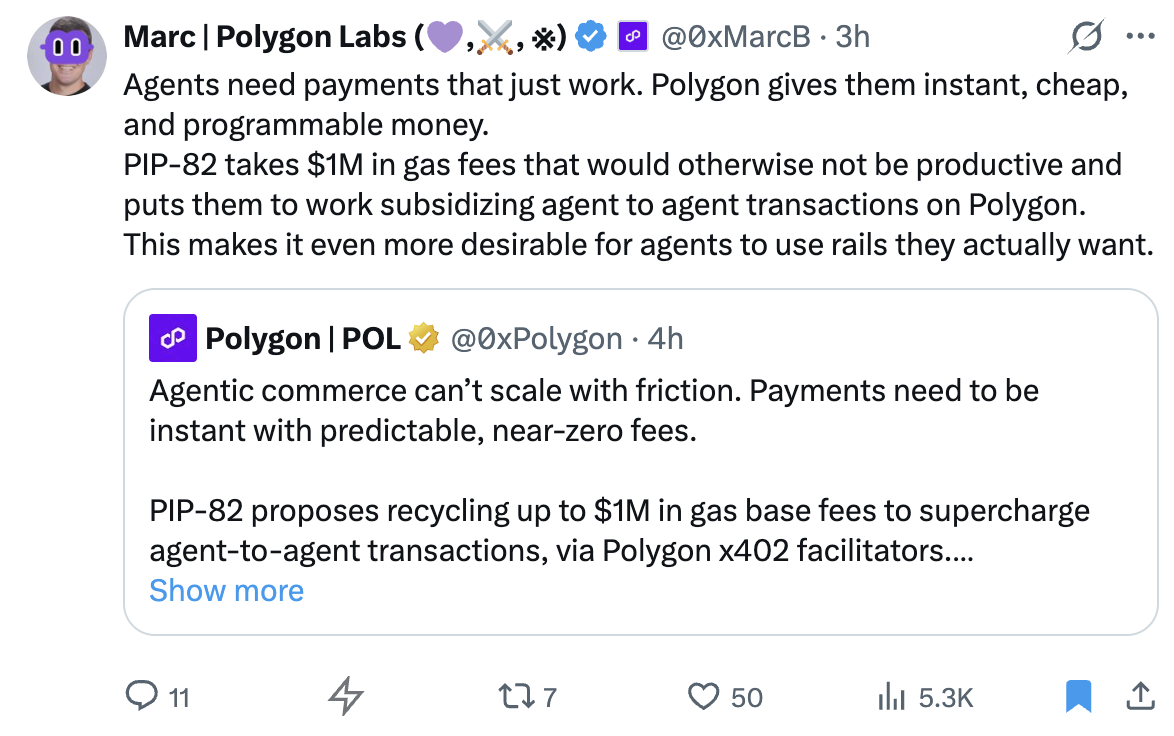
CEO of Polygon Labs post: https://x.com/0xMarcB/status/2021999894148620611?s=20
-
Polygon’s “PIP-82: Agentic Commerce Gas Program” forum discussion
Questions
-
Is agentic commerce a strategic priority for Stacks?
-
How should “agentic commerce” be defined on Stacks?
-
Which mechanism seems most appropriate: Fee Credit / Rebate Pilot or Protocol-Level Fee Recycling via PoX / PoB?
-
What risks or unintended consequences should we anticipate?
-
Should we start with a small pilot before scaling?
I believe this is the time to take action, not be conservative, not discuss ideas forever.
We need to win this race. We need to be bold.