Please find attached minutes from session 6. Thank you and happy Tuesday everyone!
Clarity Working Group — August 4, 2026
TL;DR
-
Wallet security — two-factor signing (wallet key + passkey) with configurable cooldowns blocks fast unauthorized withdrawals; recovery path handles long inactivity.
-
pox-5 post conditions — staking moves tokens, pox-5 updates unlock params. Avoid unsafe post conditions.
-
Signer manager — batch reward distribution cuts gas, stays non-custodial, makes fee policy explicit.
-
sBTC bridge — BTC rewards bridged to sBTC. ~1% fees today from bridging UTXOs individually; optimization in progress.
-
Edge cases — Xverse contract drops the withdrawal ID; fallback accounting in the signer manager recovers locked sBTC from failed withdrawals.
-
Epoch 4 — activated smoothly. Clarity WASM work resumed.
Wallet security and recovery
Two-factor signing + cooldowns (00:06) Requiring both wallet signing (Leather/Xverse) and a passkey adds a 2FA layer. Cooldowns are configurable and delay withdrawals above a set threshold — e.g. two weeks, giving you time to react if a key is compromised. If suspicious activity shows up, you can transfer wallet ownership and cut the attacker out.
Recovery for inactive wallets (01:21) Friedger Müffke originally built the recovery mechanism; Rapha is testing it now. Owners can regain control after a year of inactivity, which mitigates key loss.
Slow on-chain operations by design (02:36) Rapha: chain operations shouldn’t be as instant as a bank account, because you can’t revert them. Slower is the point — it buys detection and response time.
pox-5 contract and staking mechanics
Staking vs. pox-5 post conditions (04:33) Brice Dobry: staking post conditions carry amounts for token movement; pox-5 post conditions cover parameter changes — unlock time, signer manager updates. Rapha confirmed pox-5 changes don’t move assets immediately, they update unlocking params and trigger unlock events after the cycle completes.
Correct usage (07:04, 08:48)
-
Locking sBTC → standard FT post conditions, since tokens actually transfer into the pox-5 contract.
-
Unstaking → no immediate token movement. The pox-5 post condition must pass for unstake, bond registration, and early exit.
Unsafe post conditions (13:25) Brice advised against broad use of “unsafe” post conditions even though pox-5 is a trusted contract — the risk is accidental vulnerabilities.
Hard forks and STX unlocking (15:06) Unlocking behavior at fork time is controlled by stacks-core, not contract code. pox contracts deactivate, new ones activate, and all STX unlocks per the core team’s decision.
Signer manager and yield distribution
Batch reward distribution (09:55) Rapha built a manager that accounts for rewards at the manager contract and distributes to many stackers at once, cutting gas. Signers stay non-custodial and transparent.
FastPool’s signer manager guide (11:56) Cited as a good resource for standardizing signer policies — shows how different managers operate and enforce fee policy (max fee caps, OG user exemptions).
Non-custodial as the actual user benefit (31:15) Users want hands-free, trustless claiming with a clear fee policy. The design avoids custodial control and lets users pick a manager on fee transparency.
Tranches and reward cycles (26:28, 30:57) pox-5 uses two tranches per cycle; if no call is made, it falls through to the next tranche. Stacker Labs plans to automate the reward calculation call so payouts don’t depend on user action.
Cost vs. usability (34:55) Experimentation continues on batch claims and contract calls. Brice noted stacks-core caching already removes redundant work, but changing the cost model needs a consensus upgrade.
sBTC bridge and BTC reward distribution
How it works (28:38, 29:23) BTC rewards are bridged and converted to sBTC through a Taproot address into the pox-5 contract. Anyone can call calculate-rewards on pox-5 to distribute sBTC among signers, twice per cycle.
Fees today (33:29) ~1%, because the bridge currently bridges multiple UTXOs individually. Dan from the core team has worked on optimizing this — worth getting him into a future session.
PlanBetter’s approach (23:10, 23:43) Pays out BTC every two cycles and takes 100% fees, then redistributes to pool operators. Bypasses contract-controlled distribution — relies on off-chain conversion and operator trust.
Minimum claim amounts (25:08) Some signer manager contracts set a contract-level minimum. Rewards below it fail and roll into future cycles, avoiding small-claim inefficiency.
Contract variants and edge cases
Xverse contract drops the withdrawal request ID (18:29, 22:16) Friedger: this discourages BTC reward claims without fully preventing them — rewards are still received. Brice: the withdrawal ID is needed to reclaim a failed withdrawal, but it can be pulled from events or debugger tools.
Failed sBTC withdrawals (20:53, 21:30) Failed withdrawals can lock funds. Rapha and Friedger confirmed fallback accounting in the signer manager contract allows reclaiming the locked sBTC.
97 cycles in test (16:11, 16:44) Incrementing staking cycles beyond 96 was observed in the test environment. Brice to check whether that’s valid or a test artifact.
Epoch 4 and Clarity WASM
Epoch 4 activated smoothly (02:55) Brice led the activation. Next real test is the prepare phase for the upcoming cycle, ~7 days out.
Clarity WASM resumed (03:49) Brice is rejoining the Clarity team to push the implementation toward completion and broader use.
General confidence in the transition (17:01, 42:02) Rapha is looking to deploy the new wallet security features in production.
Action items
Brice Dobry
-
Verify the limit on staking cycle increments beyond 96 in pox-5, and follow up on the test environment inconsistency.
-
Confirm withdrawal ID handling in pox contracts; coordinate with Ken (or the relevant lead) on the Xverse contract changes affecting BTC reward support.
-
Consider inviting Dan from the core team to cover sBTC bridge mechanics and reward bridging optimization.
Friedger Müffke + Brice Dobry
- Monitor performance impact of batch contract calls; consider hard fork timing for contract call cost changes.
Rapha
- Continue testing and deploying user staking safes with the new recovery and cooldown features.
Where can you stake your STX? https://signer-guide.fastpool.org/
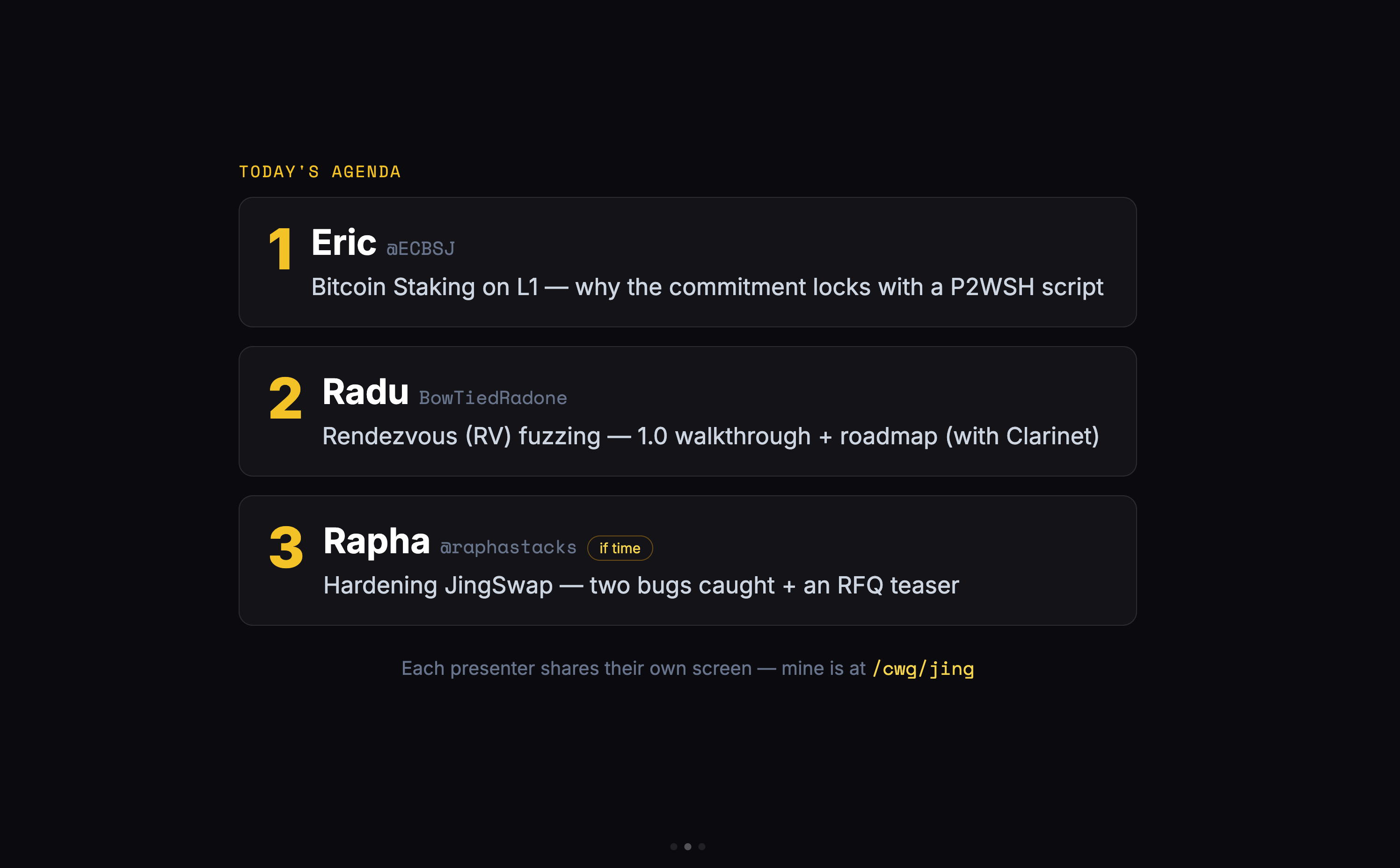
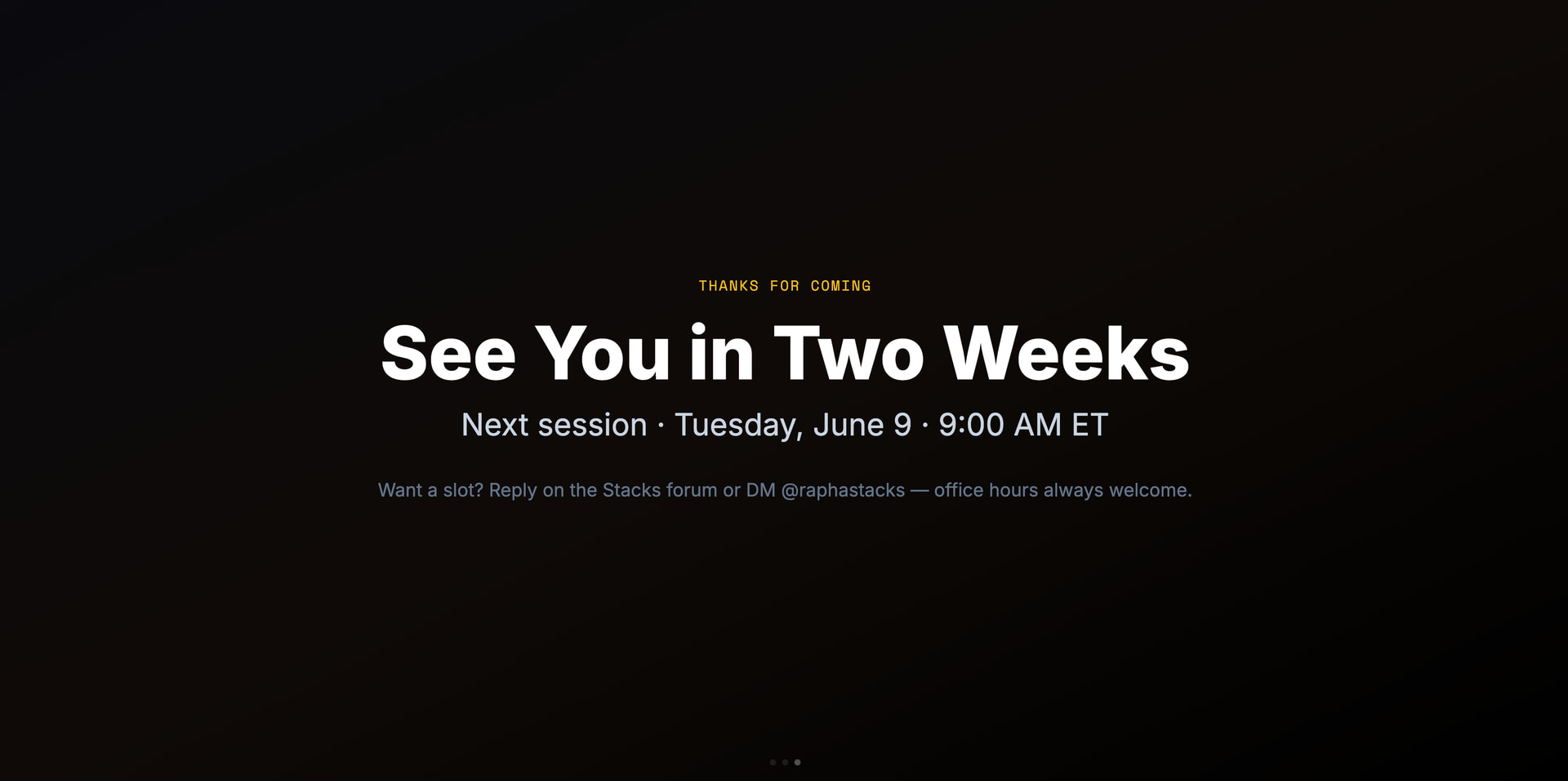


 Reminder: Clarity Working Group — tomorrow, Tuesday June 23, 9:00–9:30 AM ET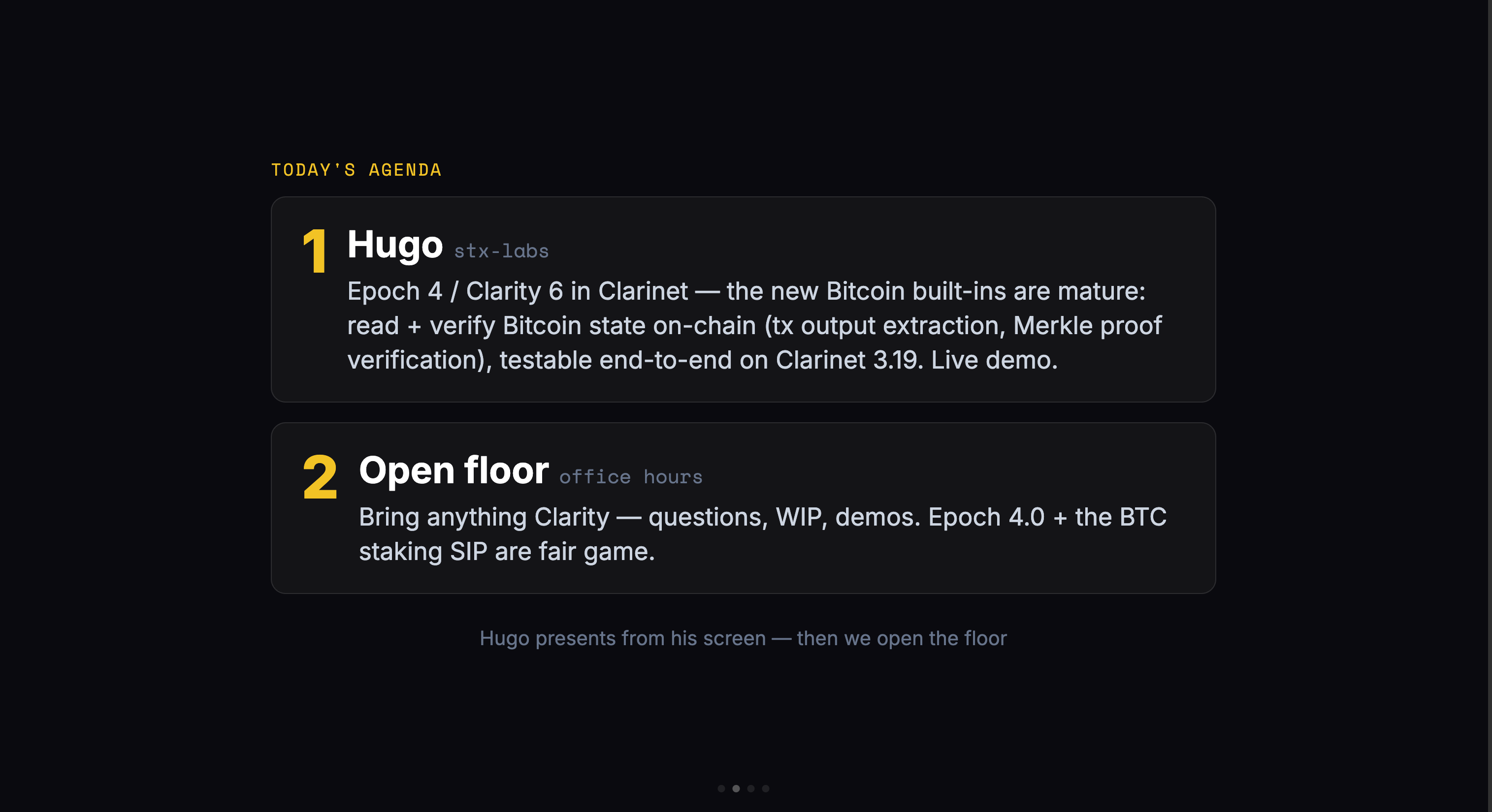

 Live demo by LabSTX (
 Open office hours — bring anything Clarity. Questions always welcome; come by even if you’re just curious.
 Clarity Working Group — Office Hours Today, Tuesday July 21 · 9:00–9:30 AM ET Same calendar event, same link.
 Stacks 4.0 & pox-5 — what actually changes for a signer. New bond/signer model, no more
  Jing RFQ is live on mainnet. Two-phase RFQ swaps with market makers hedging on CEXs. Happy to walk through the contract design — native oracle, price band, the fix-price vs fulfill split — and show a swap end to end.
 Bitcoin CLO as pristine collateral. More thought experiment than product: what it would take to structure Bitcoin-backed credit on Stacks, and which primitives are missing today.
 See you at 9 ET sharp. We keep it to 30 minutes.
 TL;DR for stackers: you unlock automatically, you don’t miss cycle 140 rewards, but you must re-lock into pox-5 during cycle 140’s reward phase — before the prepare phase starts.
 Ecosystem updates
 Action items